-
-
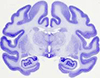
sample data
|
-
-
-
sample data

|
-
sample publication
|
|
The Anton Reiner Collection - General Information
Over a career focusing on comparative brain organization that
spanned nearly half a century (1977-2021), Anton Reiner created a
collection of immunolabeled sections for the brains of members of
diverse vertebrate taxa, often in collaboration with Glenn
Northcutt.
To avoid the loss of invaluable data in this collection, especially
for the rarer species in this collection, Reiner donated
immunostained series of sections from his collection to
BrainMaps.org, for them to scan at high resolution and make publicly
available. The species represented include rhesus monkey (Macaca
mulatta), tree shrew (Tupaia glis), the domestic cat
(Felis domesticus [listed on brainmaps.org as Felis
catus]), 13-lined ground squirrel (Ictidomys
tridecemlineatus), the tuatara (Sphenodon punctatus), the
African lungfish (Protopterus annectens), the sunfish
(Lepomis cyanellus), the Senegal bichir (Polypterus
senegalus), the longnose gar (Lepisosteus osseus), the
spiny dogfish shark (Squalus acanthias), the little skate
(Raja eglanteria), and the ratfish chimerid (Hydrolagus
colliei). Tuatara, lungfish, sunfish, gar, polypterus, shark,
skate, and chimera tissue was generated in collaboration with Glenn
Northcutt. Harvey Karten provided the 13-lined squirrel specimen.
Each section has been individually cropped and rotated and can be
viewed on the BrainMaps website, with a full-zoom resolution of up
to 0.46 microns/pixel.
For published information on the tuatara, African lungfish, the
Senegal bichir, and spiny dogfish shark in this collection, please
refer to the following papers by Reiner and Northcutt: Reiner and
Northcutt, 2026; Reiner and Northcutt, 1987; Reiner and Northcutt,
1992; Northcutt et al. (1988). Note, the slides constituting the
tuatara collection have been banked in the Harvard Museum of Comparative Zoology as part of
The R. Glenn Northcutt Collection of Comparative Vertebrate
Neuroanatomy and Embryology.
Note: The Anton Reiner Collection is a work in progress. Please
have patience as we scan and process the many species in this
invaluable collection.
|

|
|
|